Kerkis to TsikniasThe little peaks have the best view — a summit thirty years apart, from a mother to her son
Two family climbs, three decades apart. Samos in 1996 with my parents, and this summer on Tinos with my eight-year-old — the same lesson, waiting at the top.
📖 4 min read🗓️ July 2026📍 Tsiknias, Tinos, Greece
It was 1996. I was on the edge of my teenage years, and we were on the island of Samos with my parents. We had already spent a week doing what my parents always did on an island — chasing little country chapels down dirt roads, finding remote coves with no path in, wandering the jungle of Mount Karvouni. Then one morning the announcement came: today we climb Kerkis.
Kerkis is the imposing mountain that dominates the southwest of Samos. From the coast it looks unclimbable — one great grey shoulder rising straight out of the Aegean. We packed the day before: hiking boots, backpacks, the required supplies. We left early.
As we started up into an alpine meadow where the heat was becoming unbearable and the sun was showing what it could do, the questions began. Why are we doing all this? Why aren't we at a beach, on a lounger, like everyone else? Why are we doing this?
The sheepfold, and the goats that watched us climb
Soon we came upon the sheepfold of a friend of my parents from Marathokambos. He and his family took us in, offered us cheese and cucumber, and — the thing you don't forget — a lot of shade. Their worn trainers, their well-lived-in clothes, their easy smiles, their simplicity: it all told the story of a life without pretence. That memory is still with me.
We kept climbing. The wild herbs and the scattered flowers gave scent and colour to a landscape that was otherwise just stone. Every step of my boots gave a rhythm to my breathless breathing. As we went up the breeze cooled but the sun stayed hostile. We walked like nomads in a desert — covered head to toe with hats and scarves, with a water bottle that was the most precious weight in the pack.
At the little chapel of Prophet Elias we met the goats. Dozens of them. They watched every step we made, standing still on the rocks, balancing without concern on the sharp points of the ridges. We sat in the deep shade of the chapel and shared what we had. Bread. Cheese. The kind of joy that only comes when you've earned the food you're eating.
"The low little peaks — the ones on the tops of the islands — have the most beautiful view."
After that short rest we set off for the top — the little pillar of Kerkis. "We're on the final stretch now," we said, and we went up. The ground grew more barren, more sheer, more uphill, and at the same time more magical. When we reached the summit, we could look out across the surrounding islands. My eyes sank into the deep blue of the sea and got lost in the blurred line of the horizon.
Coming down, my steps felt lighter than they had ever felt. My feet were tired from the heavy boots and my soles hot from the wool socks, but something else had shifted. I said goodbye to the dark shapes of the goats in the glare of the sun with a strange kind of gratitude — they had walked me down as well as up. I felt lighter than ever. Calmer. More sure of myself. I had found my answers to the morning's questions.
Because the low little peaks — the ones on the tops of islands — really do have the most beautiful view.
• • •
Thirty years later, on Tsiknias
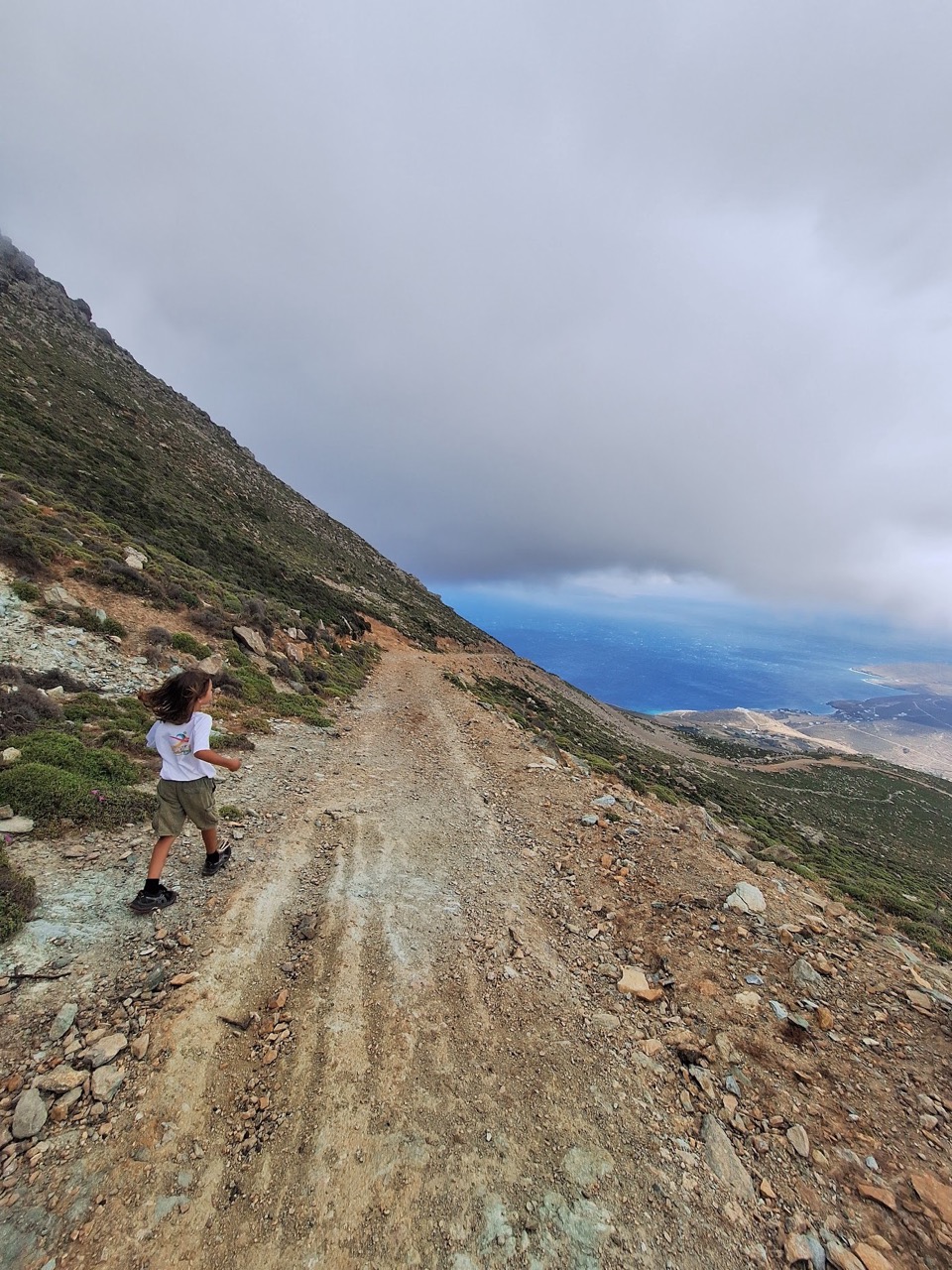
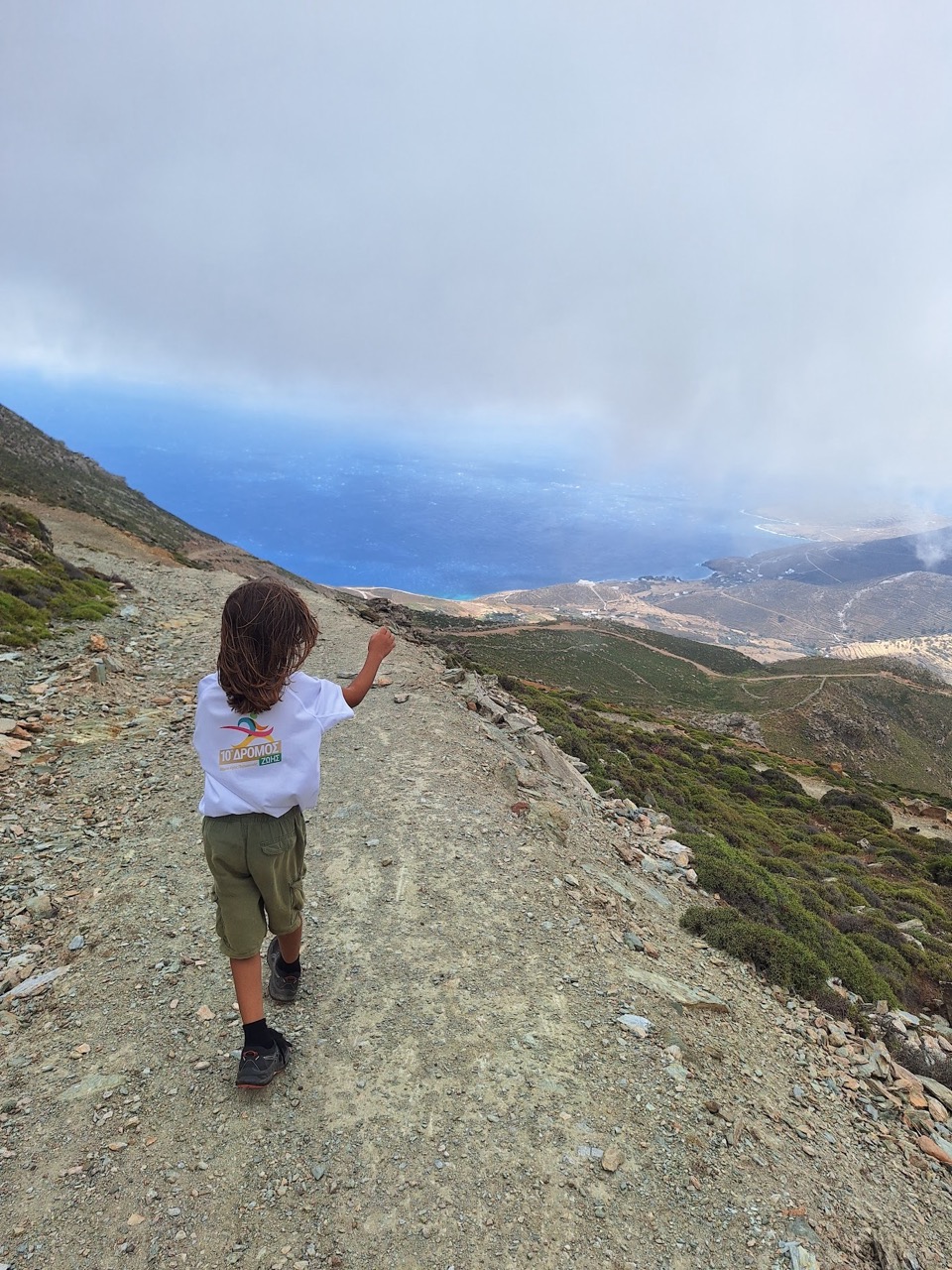
This summer, my eight-year-old son climbed Mount Tsiknias on Tinos.
Tsiknias isn't Kerkis — it's a Cycladic mountain, lower, rounder, weathered by centuries of wind. But it holds the same shape in the family imagination: the imposing summit above the village, the one everyone points at from the port, the one where you're not supposed to go with a small child. Which is exactly where you should take a small child.
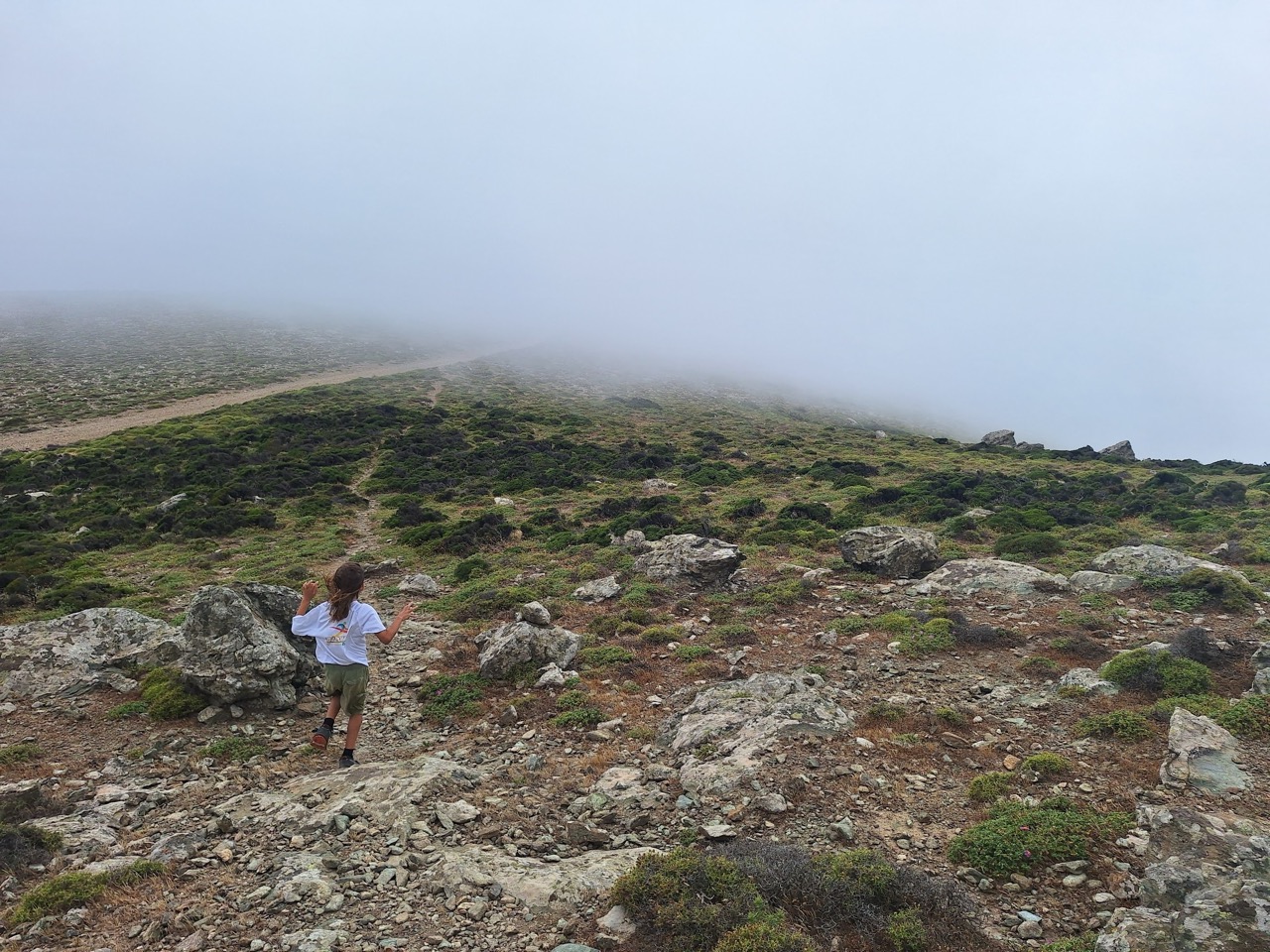
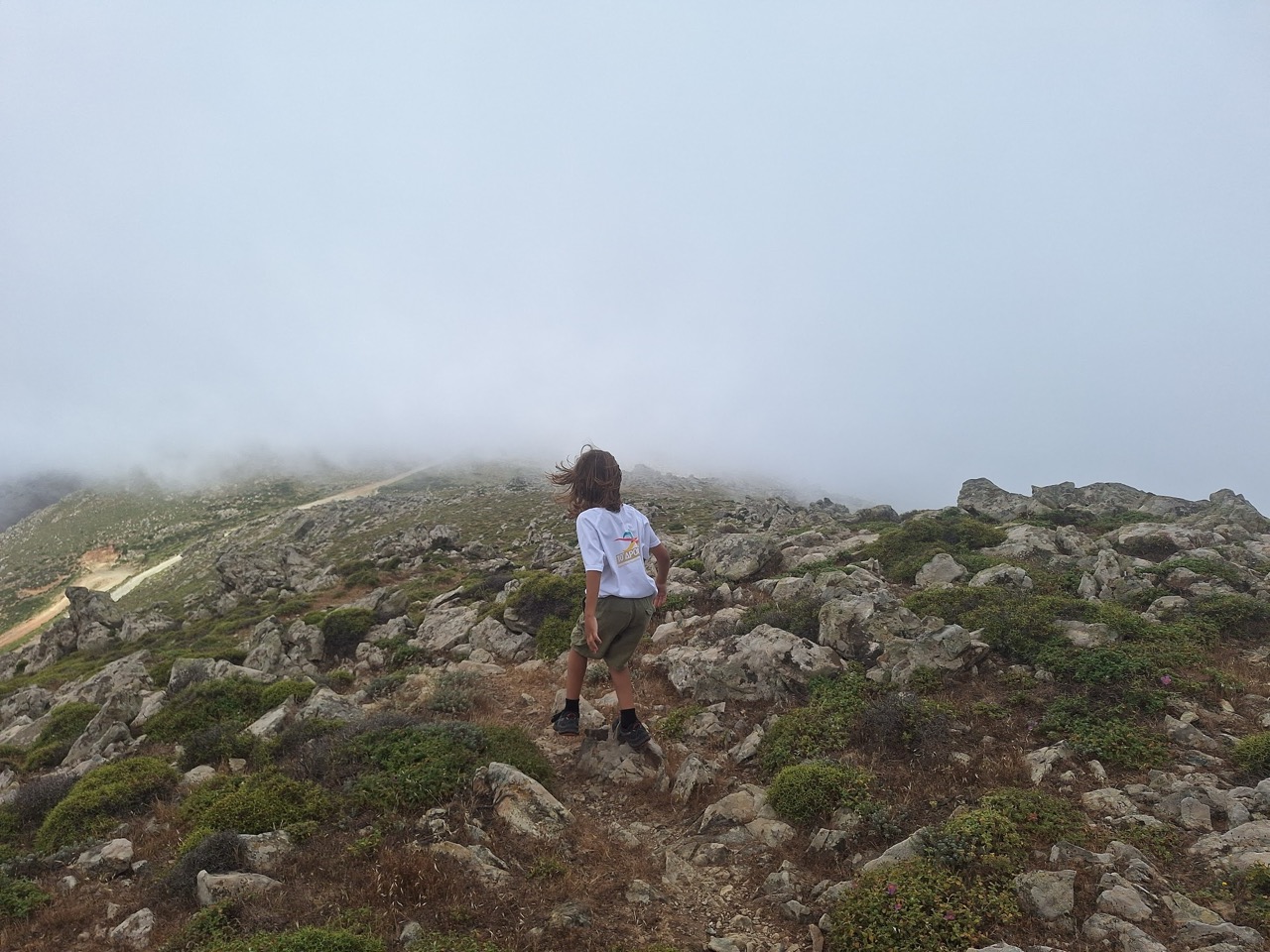
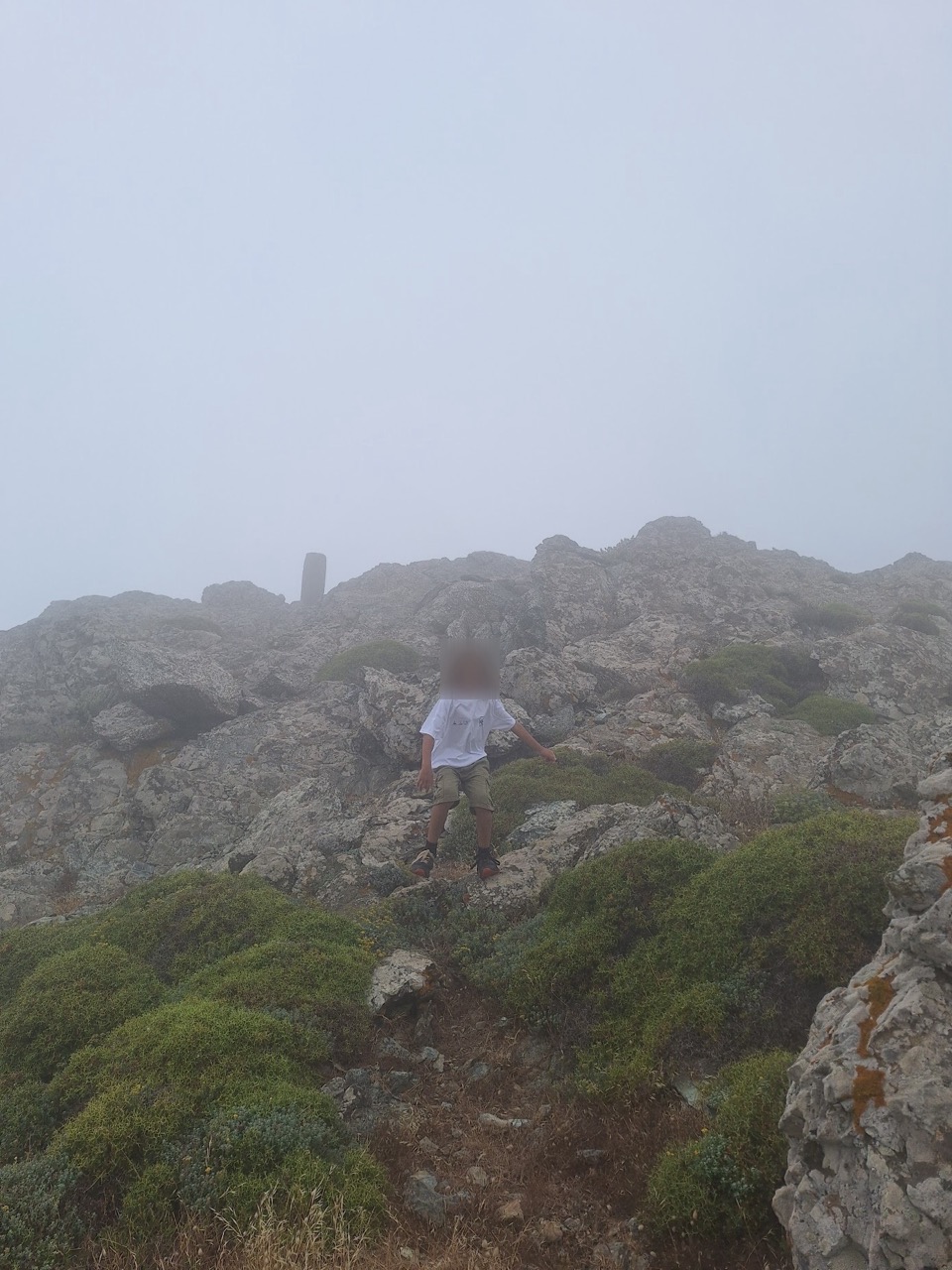
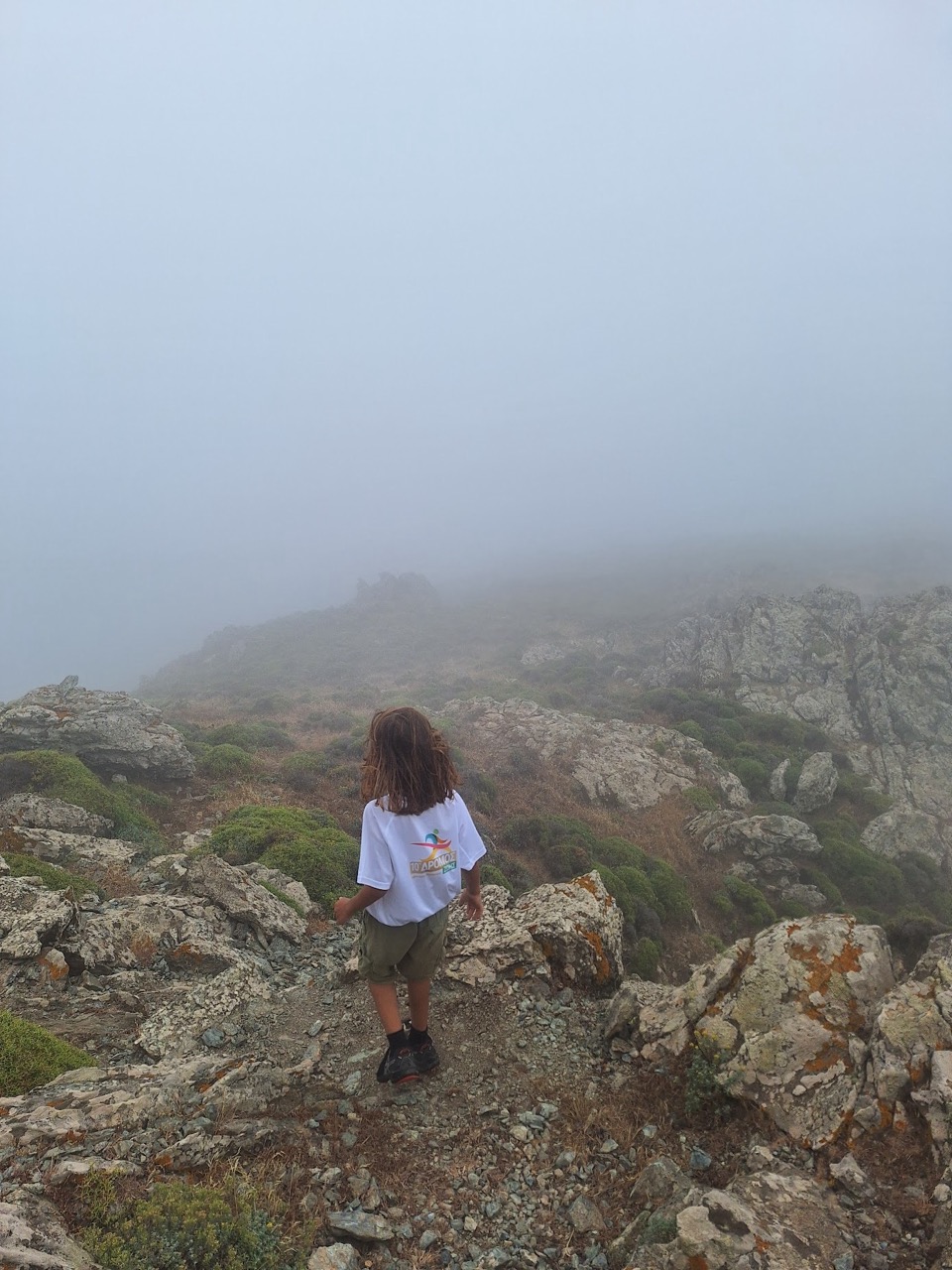
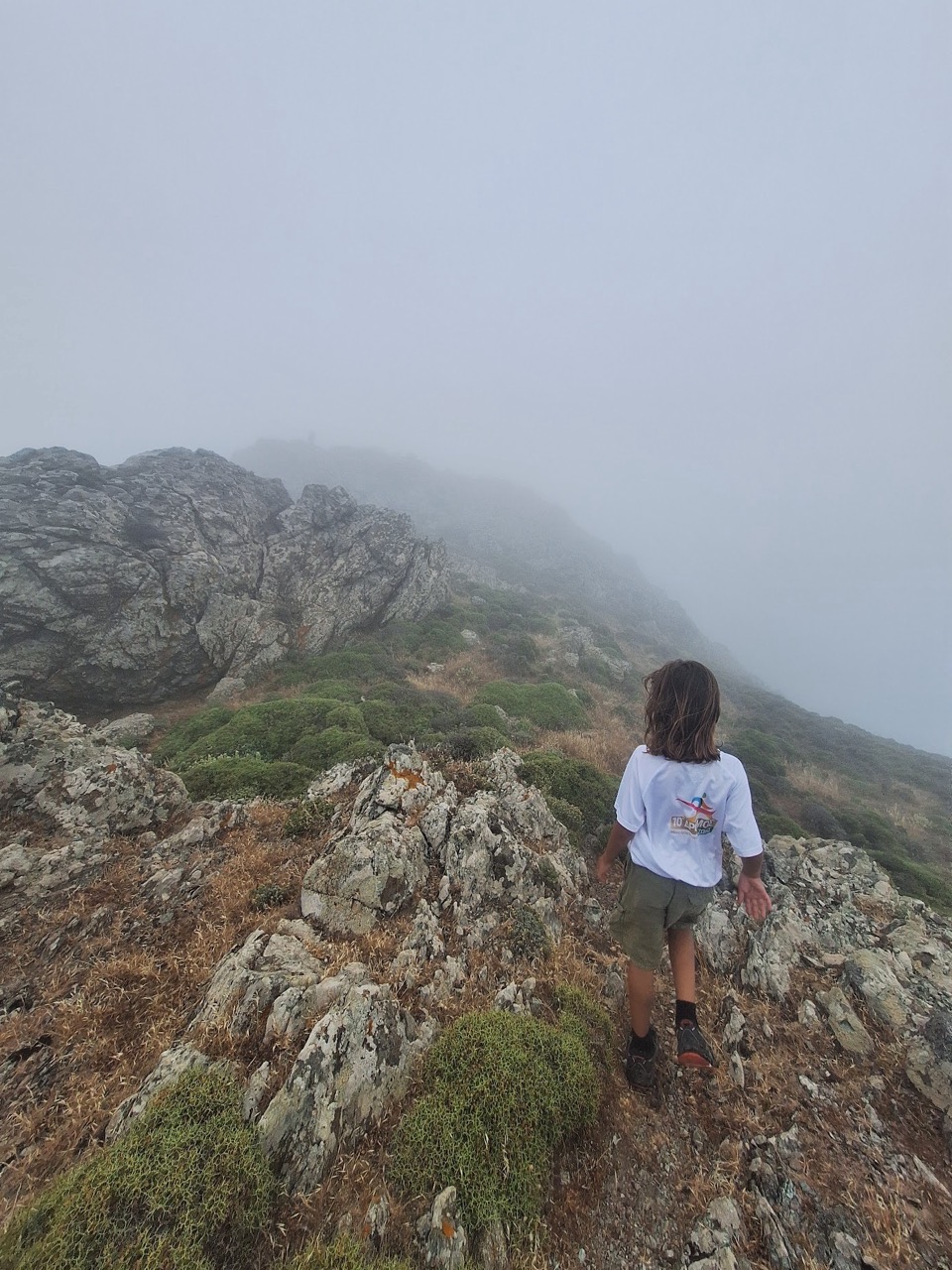
The clouds didn't give him the panorama I'd promised him at the base. The horizon we'd talked about the night before was replaced with a wall of white. But something else happened up there instead — the wildness of the mist and the granite and the wind left its own imprint. He came down quieter than he went up, holding my hand a little tighter, already asking when we'd go back.
The lower ridge. Loose stones, no marked path, and the kind of terrain where every step is a small decision.Cycladic granite, rounded by centuries of wind. Tinos wears its mountains softer than Samos does.The mist coming up from the valley. This was meant to be the sea view I'd promised him.The rest stop. Water, a handful of nuts, and the questions I used to ask my parents in 1996.The summit rock. No view — just cloud, wind, and the small human being who now knows what it feels like to earn a place.Coming down. Lighter steps, quieter head, and a promise to come back when the sky is clear.
• • •
What gets passed on
Some of the things we hope to pass on to our children arrive through words. Most of them don't. They arrive through what we choose to do on a Sunday morning when it would have been easier to stay at the beach. Through what we pack in the backpack. Through what we say when someone small is out of breath, halfway up.
My parents took me up Kerkis because that's what their idea of a good summer day looked like. I took my son up Tsiknias because — thirty years later — it turns out to be my idea too. Same lesson, waiting at the top: the low little peaks have the most beautiful view. And when the view isn't there, the climb is.
He'll go back to Tsiknias. And one day, if we've been lucky, he'll take someone smaller than him up a mountain neither of them has any real reason to be on. That's the thing you can plan for, but you can't force.
Tell Famila.Travel your dates and your kids' ages — it'll build an itinerary around your family, so mornings like this one end up on your plan, not just on someone else's.