Chasing shade and cool water on the 15th of AugustAn August getaway to the Zagorochoria — Papingo, the Voidomatis, and the Aoos gorge above Konitsa
When the coast turns to concrete and heat, we headed inland. Two Papingo villages, a stone-carved rock pool, a five-and-a-half-kilometre walk beside a turquoise river, and a raft ride back to where we started.
📖 6 min read🗓️ August 2026📍 Zagori, Epirus, Greece
Every year around the 15th of August, the same instinct kicks in: the beaches are packed, the tarmac is soft, and the only sensible thing to do is drive uphill until the air changes. This year that meant crossing to Epirus and disappearing into the Zagorochoria — the cluster of stone-built villages tucked into the folds of the Pindos, at the northwest edge of the country.
We based ourselves in Mikro Papingo, took day trips out from there, and spent four days doing more or less the same thing: walking somewhere with shade, ending up next to cold water, and being back in the village square by dusk.
The trip at a glance
When: the week around the 15th of August
Where: Megalo & Mikro Papingo, the Voidomatis river, Konitsa & the Aoos gorge
Base: a small guesthouse in Mikro Papingo — quiet, cool at night, ten minutes' drive from the Kolymbithres trailhead
Kids: ours were 3 and 6 at the time; the baby carrier did a lot of work
What we chased: shade, plane trees, and the kind of cold river water that resets your body temperature in about ten seconds
• • •
Megalo Papingo — a playground under the Astraka Towers
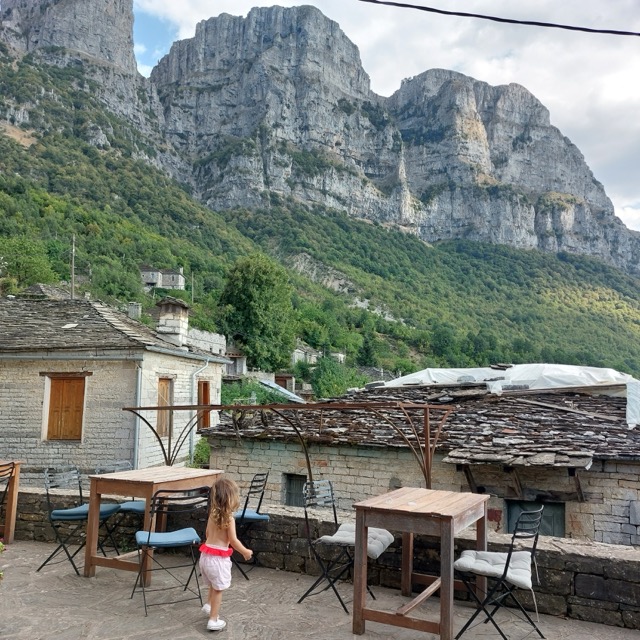
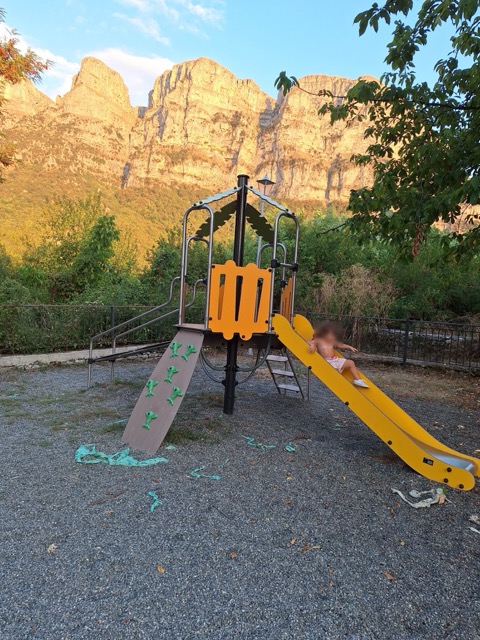
On the slopes of Mount Tymfi, at about 1,000 metres, sits Megalo Papingo. The village square opens onto the towers of Astraka — the sheer grey wall you keep noticing whichever direction you turn — and just off the square there's a small playground with the same view.
It's an easy thing to overlook, but on a hot afternoon it's exactly where you end up. Kids on bright yellow slides. Colourful bikes leaning against the stone walls. The heavy wooden doors of the old houses on one side, the cobbled kalderimia underfoot, and the massif above. The playground shouts add something the village didn't quite have on its own — a bit of everyday life, a bit of the present tense.
Around the square you'll find a handful of small shops: traditional sweets, honey and preserves, hand-carved wooden pieces — flutes, spoons, small carved figures — the sort of thing you don't plan to buy and then leave with anyway.
The Megalo Papingo playground at end-of-day light. The Astraka Towers behind, chalk drawings on the tarmac, and the yellow slide that our smallest didn't want to leave.
• • •
The Papingo rock pools
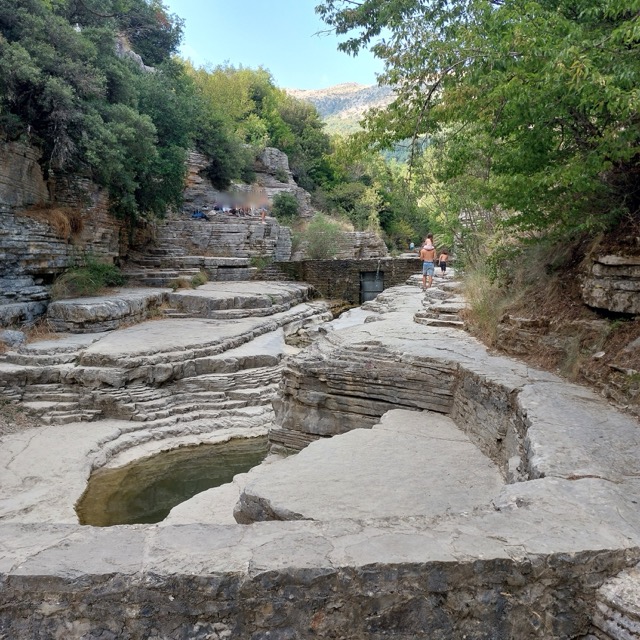
On the road between Megalo and Mikro Papingo, at about 960 metres, a short marked path drops off to the left. That's the trailhead for the Kolymbithres — the Ovires Rogovou, better known in English as the Papingo rock pools.
A stream has spent a very long time working on the limestone here, and what it has left behind is a series of stepped basins carved directly into the rock — natural pools the size of small bathtubs, one flowing into the next, with the stone smoothed to a soft grey polish along the water line.
The first part of the trail is easy — a family with young kids can walk it without much fuss. Further in, the path narrows and gets slippery, and you have to pay proper attention with children. But even the first pools are worth the walk. The formations aren't obviously spectacular in a photograph; they reveal themselves when you sit next to them for a while and start to read what the water has done.
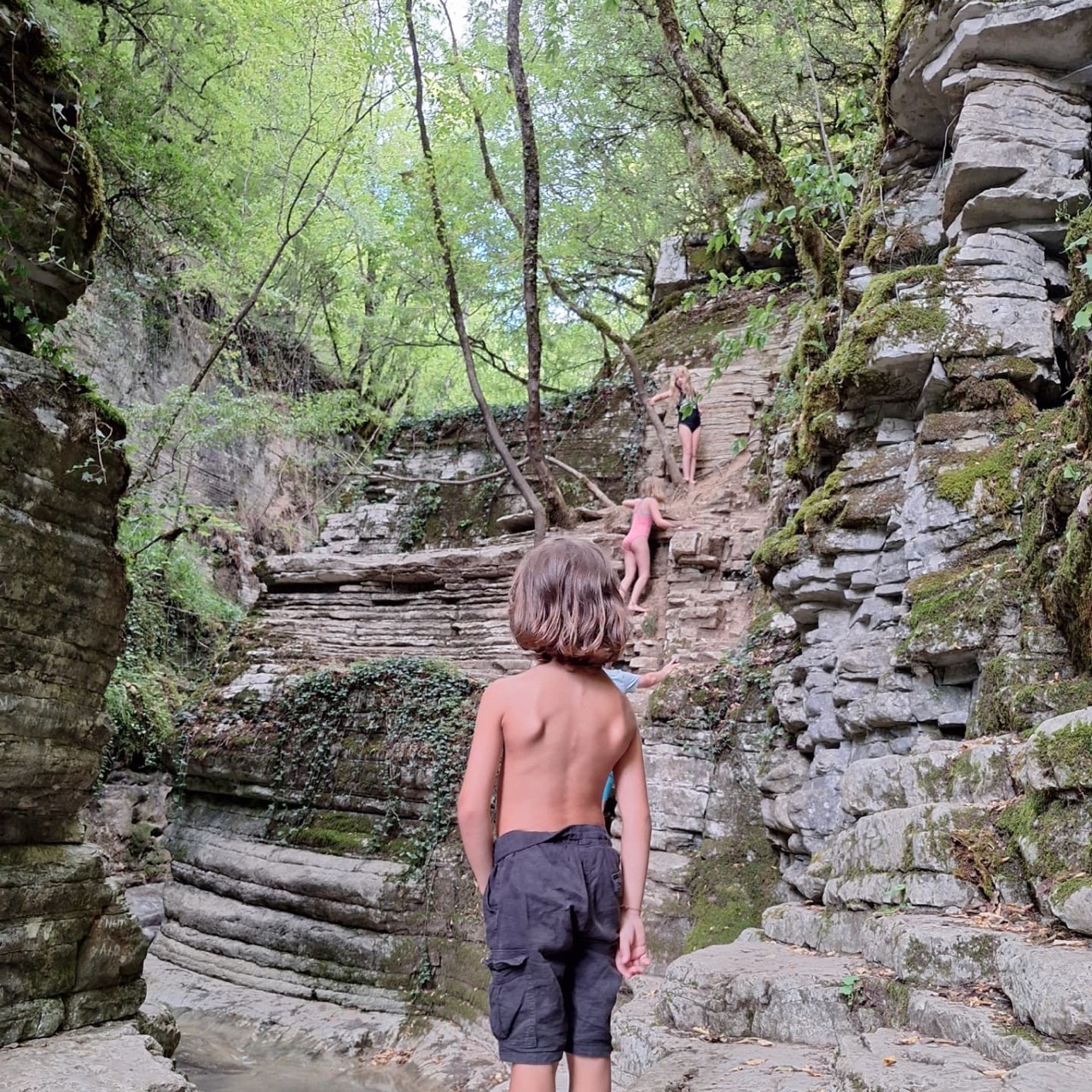
The Kolymbithres. Each little basin was carved by the same trickle of water, working for a very long time. In August you get maybe an inch of flow — enough to fill them, not enough to move them.Further in, the path stops being a path. You're on the rock itself, using the ledges and the odd rope as steps. Not for tiny kids, but for the six-year-old this was the best part of the trip — that's her going up next to the pink swimsuit.
• • •
The Voidomatis trail — Klidonia bridge to Aristi bridge
The centrepiece of the trip was a walk along the Voidomatis, from the Klidonia bridge up to the Aristi bridge. About 5.5 km, roughly two hours at a family pace, almost no elevation change, and — critically — plane trees the whole way.
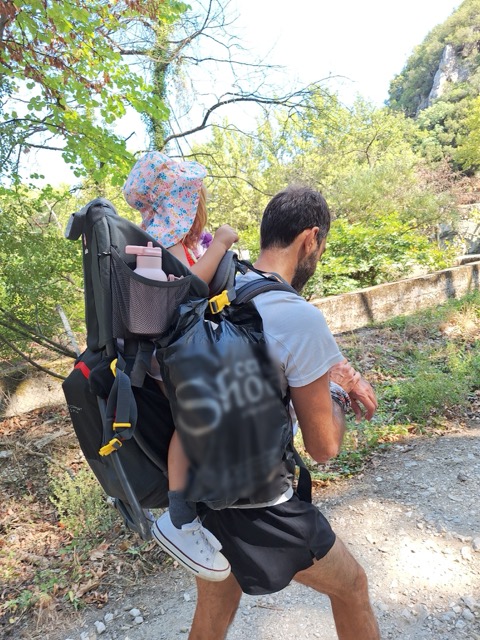
Our morning went like this: a slow breakfast at the guesthouse in Mikro Papingo, drive down to Klidonia, load up on water and snacks at the bridge, and start walking upstream. The baby carrier came out of the boot and did what it always does — turned a three-year-old's non-negotiable "I don't want to walk" into "look at the birds from up here."
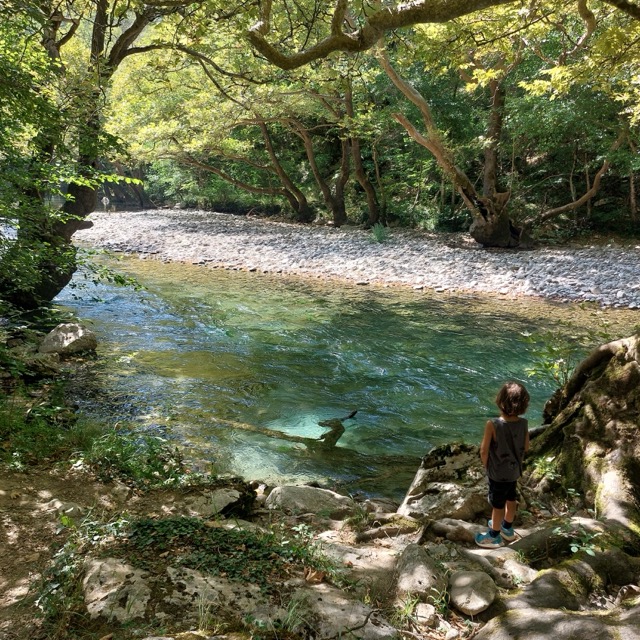
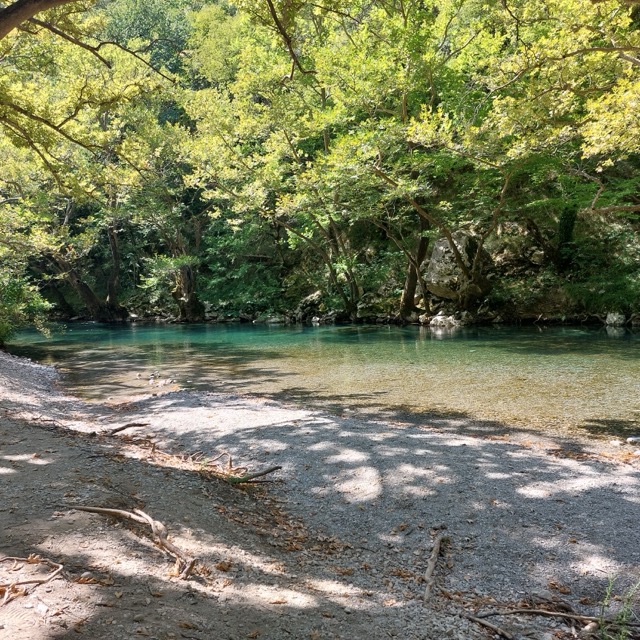
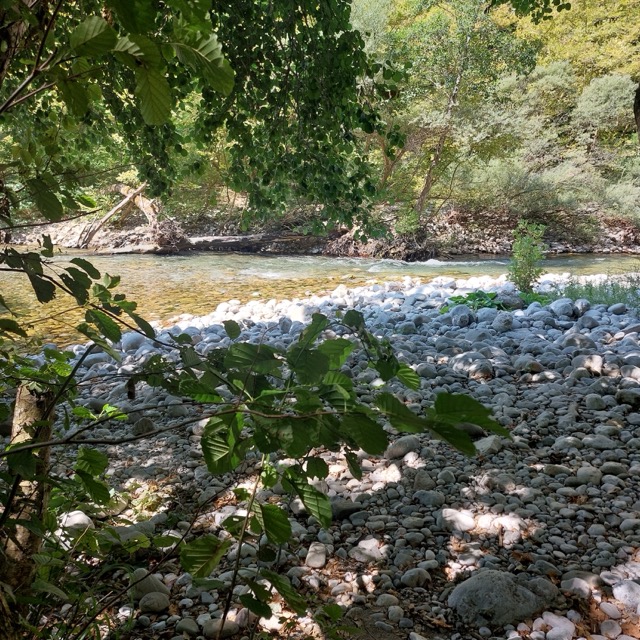
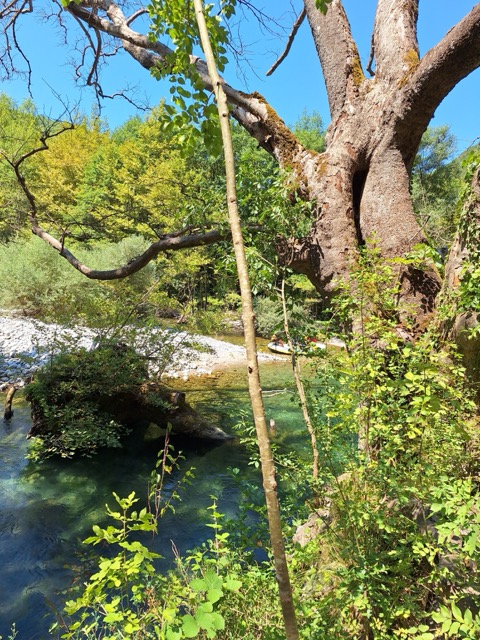
The trail is well-signed. It runs alongside the river the whole way, cutting through a dense plane-tree forest that never lets full sun onto the path. Every so often the trees open up onto a small pebble or sand beach with the Voidomatis right there — glacially cold, unreasonably turquoise. The kids kept wanting to stop and get in, and we let them.
Timing note: avoid this walk after heavy rain or in spring melt. The Voidomatis is a small, gentle river in August. In April it's a different animal, and this trail is not the place to find that out.
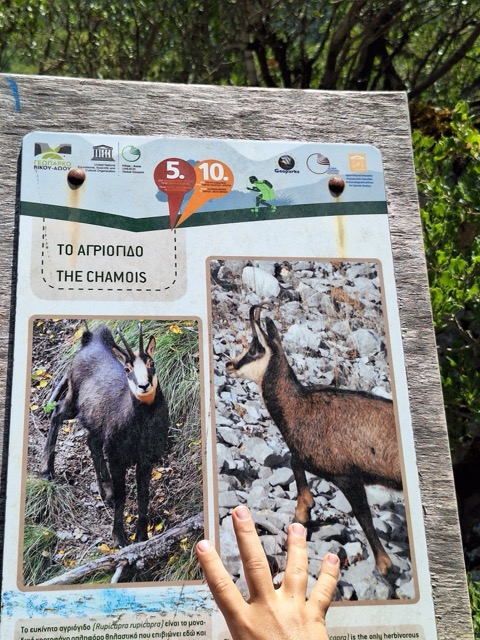
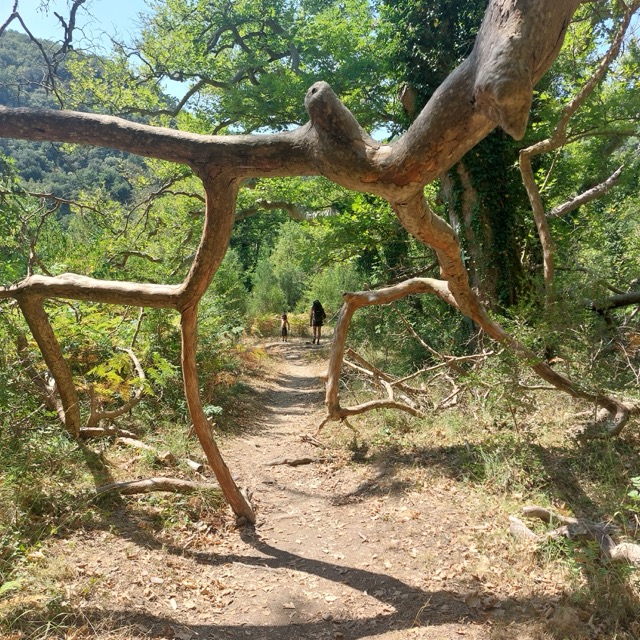
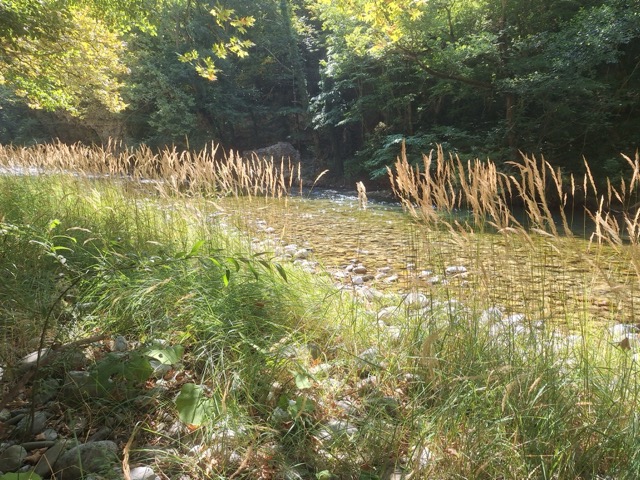
The first sign at the trailhead — the Vikos–Aoos Geopark boards, telling you what lives here. Chamois on this one; you're unlikely to see them, but knowing they're up there changes how the ridges feel.The three-year-old, up on the baby carrier for the flat first kilometre. She fell asleep somewhere around the second bend and stayed asleep until the first river beach.The gate-of-branches, about halfway along. The trail here is a soft dirt track under the plane canopy — no stones, no roots, just the kind of surface small feet can manage on their own.The first opening in the trees. Reeds up to your waist, the river flat and glassy, and a single figure in the middle distance already looking for a place to put their feet in.The colour is real — the Voidomatis is fed by karst springs and stays this shade of turquoise almost year-round. Water temperature: about 6 °C, all summer. The six-year-old lasted maybe forty seconds.One of the little beaches along the way. Enough sand to sit on, enough shade to stay in, and a slow bend of the river where the water almost stops moving.The one place along the trail with anything you could call a rapid — a small white line of foam against the far bank, and about a metre of drop.Coming out of the tree cover with the ridge above Aristi in view. From here it's about twenty minutes to the concrete bridge and the pickup point.The old plane at the deep pool. The trunk has spent decades leaning further and further over the water; the roots on the bank have grown into a small wall to hold it up.
The Aristi bridge — and rafting back
The trail ends at the concrete road bridge at Aristi. It's not the prettiest structure of the trip — but underneath it the river opens into a wide, shallow basin with natural pools in the riverbed, and on an August afternoon it's full of people cooling off. Cars stop on the bridge, people climb down, kids splash around in the pools. It has the feel of a village swimming spot, not a tourist site.
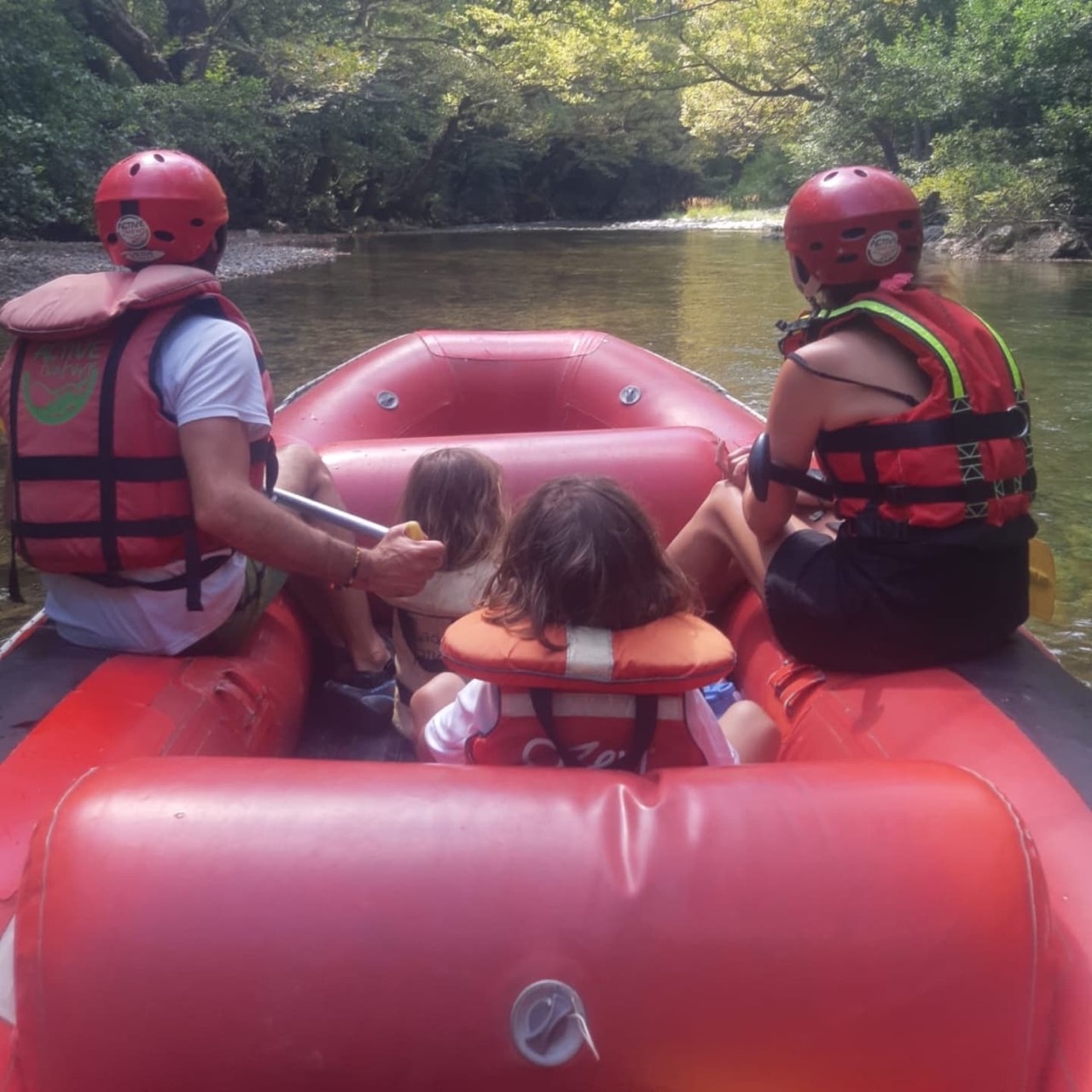
This is also where the rafting outfits put in. Several local companies run gentle raft trips down the Voidomatis from Aristi to the Klidonia bridge — the exact reverse of the walk we'd just done. We booked one on the spot. Life jackets on, paddles handed out, a very short safety briefing, and off. In August the river is calm and the ride is more of a float than a rush — perfect for kids. We drifted back to our starting point under the same trees we'd walked past three hours earlier, and pulled out at Klidonia exactly where the car was waiting.
Best €25 each we spent all week.
Halfway down, from the middle of the raft. The kids stopped talking about ten seconds in and just watched — the same plane trees we'd walked past all morning, only now sliding past at river speed.
• • •
Konitsa and the walk to Stomio monastery
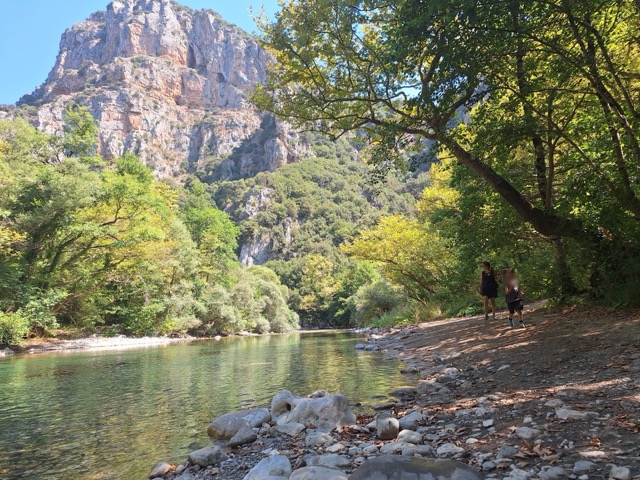
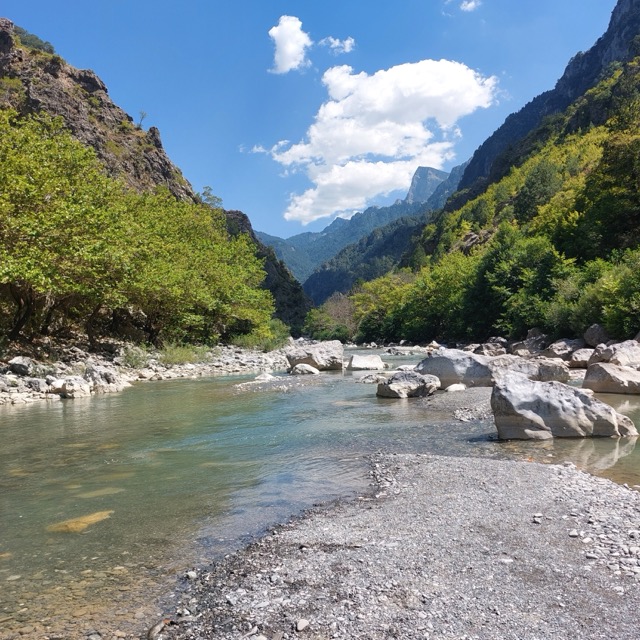
On the day we were leaving Zagori, we went the long way home via Konitsa, and walked the dirt road that follows the Aoos river upstream towards the Monastery of Stomio. It's a wide, flat, well-shaded track — not a difficult walk — and it's also where the wild trail down from the Drakolimni (Dragon Lake) of Tymfi comes out. If you've done the two-day loop up to the lake from Papingo, this is where you finish; walking it in the other direction, you get the ending without the climb.
Honesty note: parts of the riverside near Konitsa show the wear of the last few years. Human interventions haven't always been kind — some concreting, some rubbish along the more accessible spots. But the Vikos–Aoos National Park is still the Vikos–Aoos National Park. The gorge is still one of the deepest in Europe by ratio, the water is still an unreal colour, and once you're twenty minutes in from the road, the noise falls away and it's just the river.
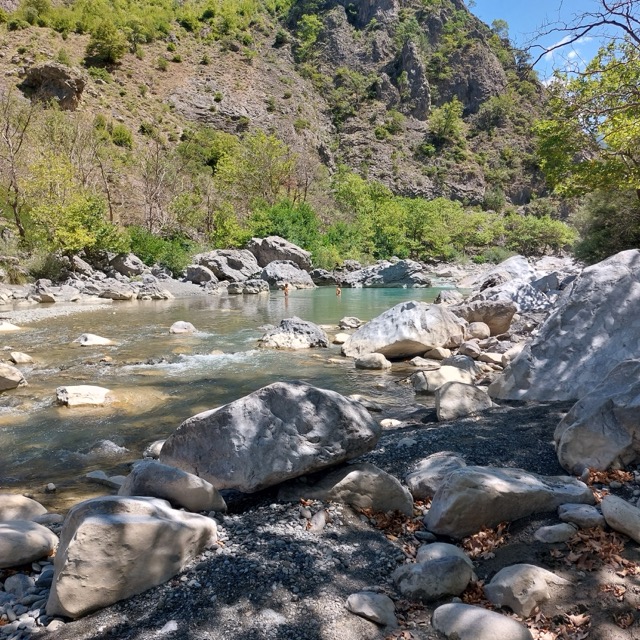
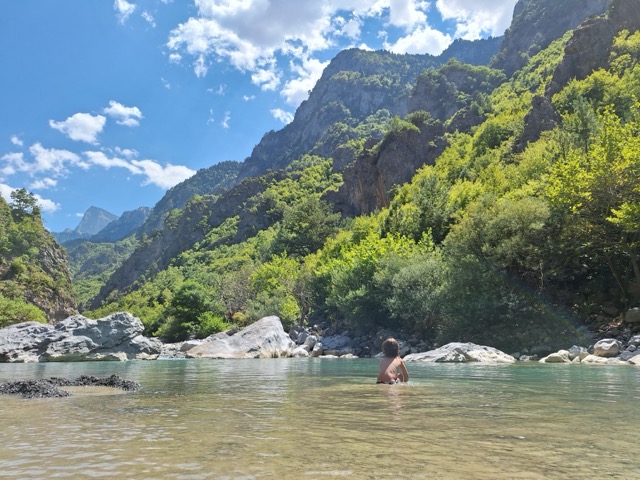
The Aoos, about a kilometre up the track from Konitsa. Wide, low, and framed by the far end of the Tymfi massif — the peak in the distance is roughly what you were looking at from the Papingo playground, seen from the other side.One of the natural pools you find by climbing down off the track. The water is deep enough to swim, cold enough to remember, and quiet enough on a weekday morning that you might be the only people in it.Looking upstream from the middle of the pool. The peaks above are the western walls of the Vikos–Aoos park — the same range the Drakolimni trail crosses on its way down.
• • •
Why go to Zagori in August, of all months
Everyone tells you Zagori is a spring or autumn place — the rivers full, the leaves turning, the light long. They're right. But August has its own case: the plane forests are dense and dark, the rivers are safe enough for kids, and the villages are alive without being overwhelmed. You need to book ahead, and you need to accept that you're not going to have the Kolymbithres to yourself. In exchange, you get shade, cold water, and a temperature drop of about ten degrees from wherever you were before.
Ours came home with sand in their shoes and a favourite river. We came home with the feeling that we'd found the trick to the middle of August — which is, mostly, to be somewhere with a lot of trees.
Planning a family escape into the Greek mountains?
Tell Famila.Travel your dates and your kids' ages — it'll build an itinerary that puts you in the shade when you need to be there, and next to cold water when the coast is on fire.