How I Used AI to Plan a Family Trip(And What Actually Worked)
Planning a family vacation used to take me weeks. Here's how AI changed that — and what tools are actually worth using.
📖 7 min read🗓️ May 2026✍️ Famila.Travel
Every parent knows the feeling. You open a new browser tab, type "best family vacation ideas," and three hours later you have 47 tabs open, a headache, and no actual plan.
Flights for four. Hotels that work for kids and adults. Activities a 5-year-old and a 10-year-old will both enjoy. A budget that doesn't require a second mortgage. It's a lot to juggle — and most travel planning tools simply aren't built with families in mind.
So when AI travel planning started getting popular, I was skeptical but curious. Could it actually handle the complexity of planning a family trip? I spent time testing different approaches, and here's what I actually found.
What I needed (that most planners miss)
Before getting into the tools, it's worth naming what makes family travel planning uniquely hard:
Age-appropriate activities — what works for a toddler is a nightmare for a 12-year-old, and vice versa.
Pacing — families can't do 8 activities a day. You need buffer time, rest days, and nap windows.
Budget clarity — not just "estimate," but a real breakdown across flights, accommodation, food, and activities.
Flight logistics — finding return flights for 4 people across specific dates is genuinely complex.
Weather — you need to know what you're walking into, not just "summer in Greece is warm."
Most generic AI tools handle some of these. The best ones handle all of them.
Using ChatGPT: powerful but incomplete
The first thing most people try is ChatGPT, and it's genuinely impressive for a starting point. If you give it a detailed prompt — ages of your kids, budget, dates, preferred pace — it will produce a day-by-day itinerary that's often surprisingly good.
The problem is everything that comes after the itinerary.
ChatGPT doesn't know current flight prices. It can't show you what the weather will actually be during your trip. It doesn't integrate with booking platforms. And if you want to adjust something — swap a day, add a stop, change the budget — you're starting a whole new conversation.
For families, the gap between "AI-generated itinerary" and "actual trip booked" is still very wide with ChatGPT alone.
What purpose-built AI trip planners do differently
This is where tools built specifically for travel planning pull ahead. Instead of a conversational back-and-forth, they structure the entire planning process: destination, dates, traveler profile (adults + kids + ages), budget, travel style — all in one flow.
The output isn't just text. It's an actual plan with:
Real flight options with pricing
Accommodation suggestions linked to booking platforms
Day-by-day itineraries with timing and kid-friendly activity notes
Live weather for your exact travel dates
A budget breakdown across categories
We built Famila.Travel specifically for this — a family trip planner that takes your kids' ages seriously and builds the plan around them, not around a generic traveler. You tell it where you want to go (or ask it to suggest somewhere), your travel dates, how many adults and children, and your budget. It handles the rest.
What surprised users most was how it handles complex trip types: not just simple roundtrip flights, but road trips, hybrid flight-and-drive combinations, and multi-stop journeys — the kind of trips families actually take.
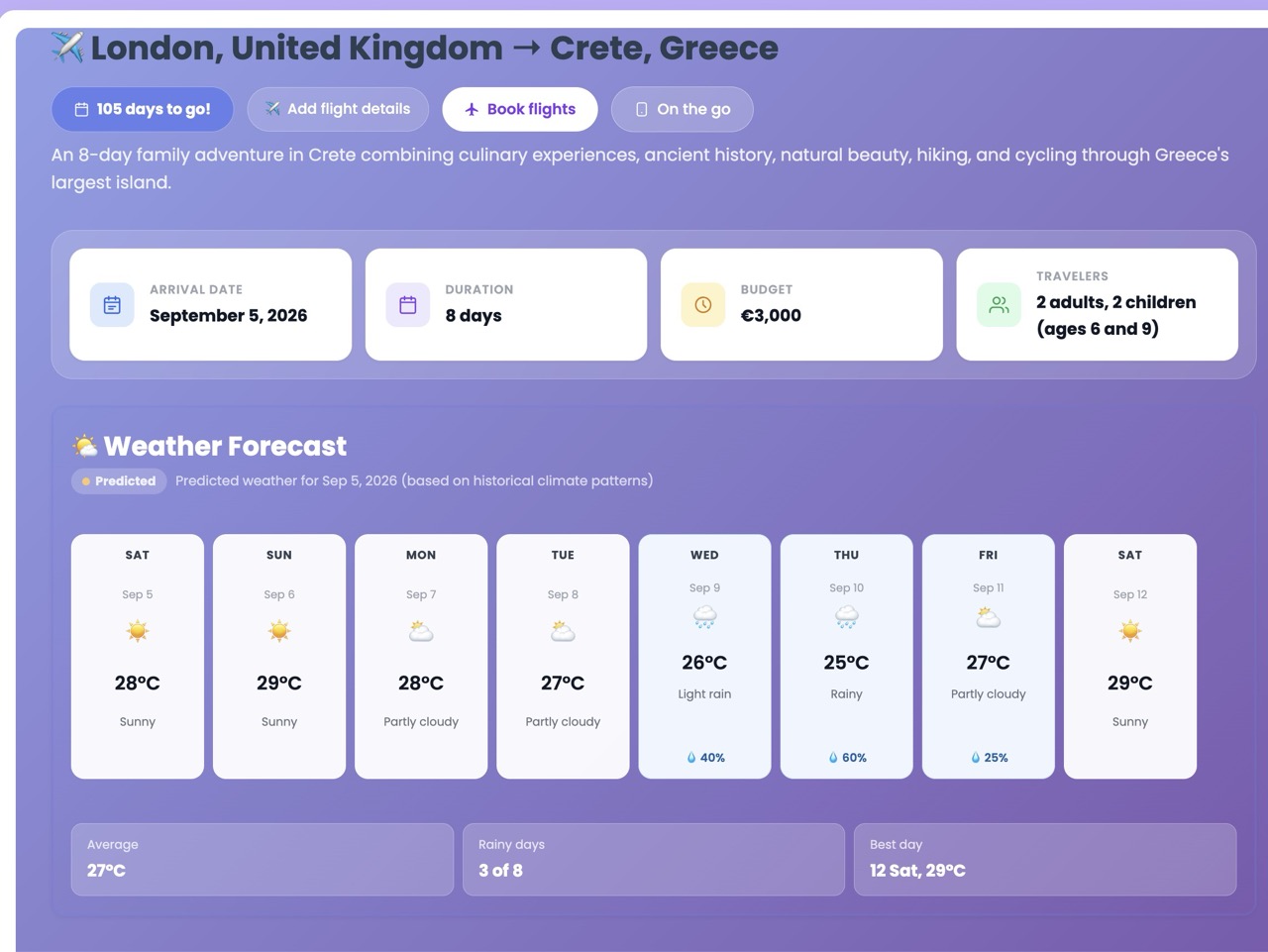
Trip overview — destination, dates, travelers, budget, and an eight-day weather forecast keyed to the exact travel days.
Note: the shared link is a read-only view. The interactive bits — flight search, booking.com links, flight-delay tracking — only appear in the owner's view.
Input
2 adults, 1 child aged 6, 1 child aged 9. Flying from London. 8 days in September. Budget: €3,000 total. Travel style: relaxed beach with some culture, plus hiking and cycling.
What the AI generated
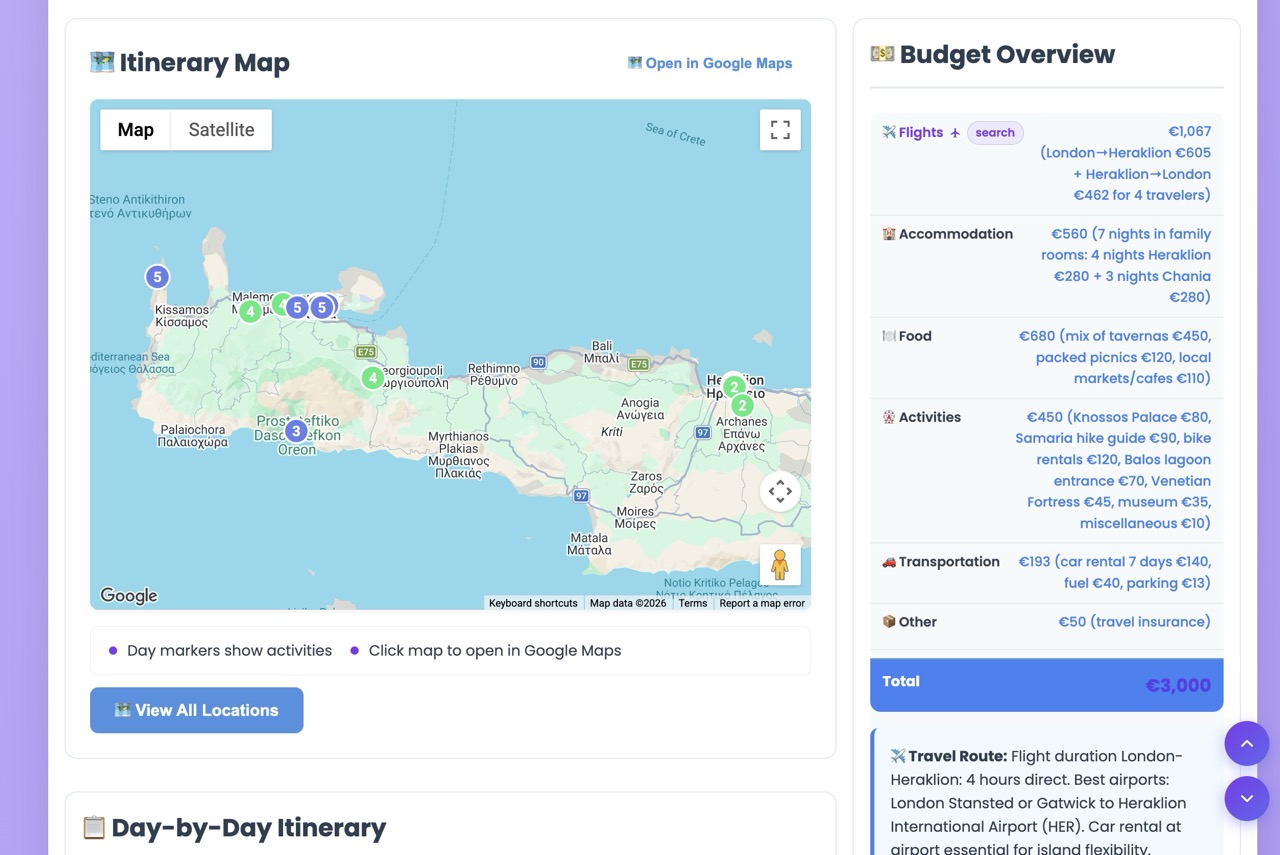
Flights priced for four: London → Heraklion €605 outbound, €462 return (~€1,067 all-in)
4 nights in Heraklion, then 3 in Chania — shifting west for a slower second half
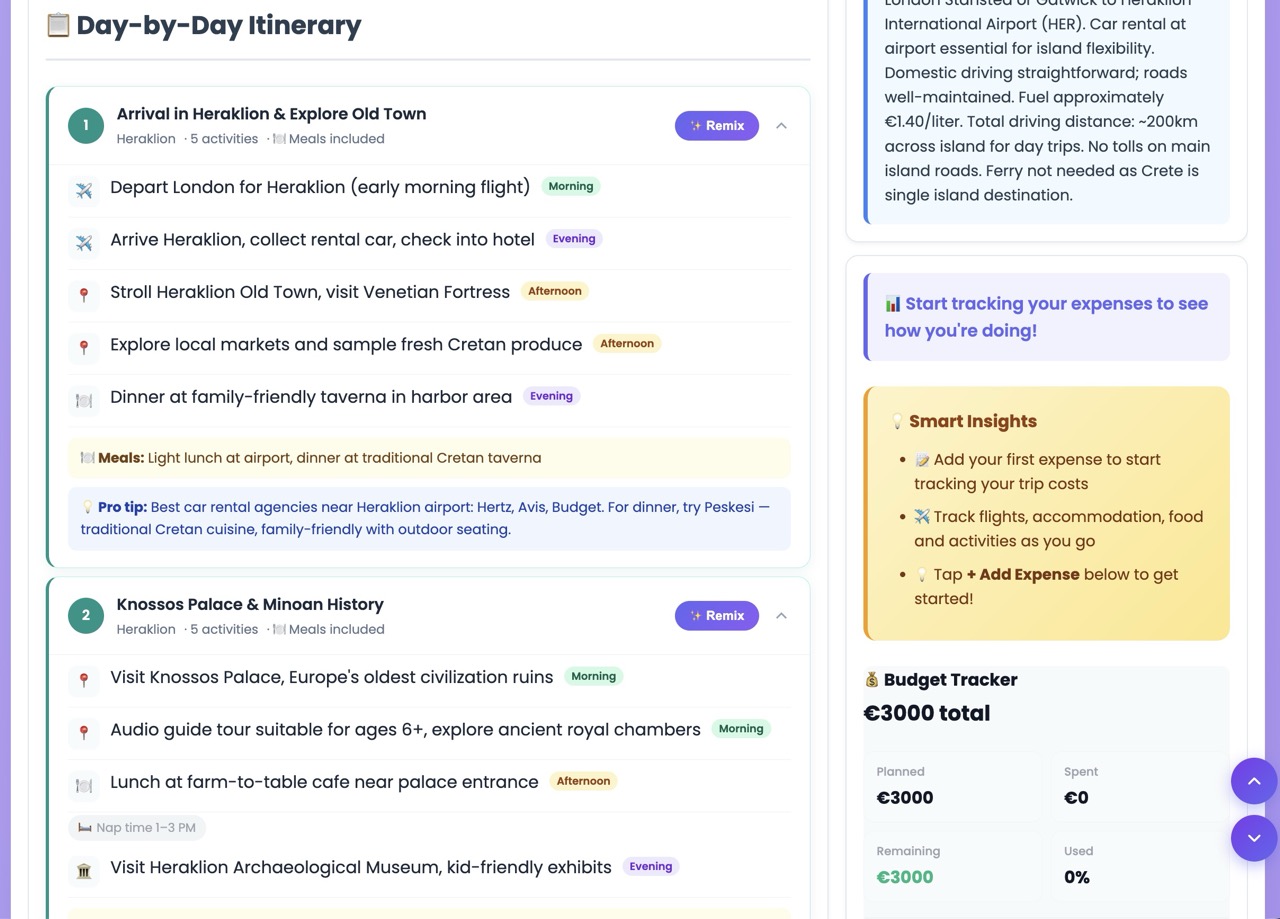
Day-by-day itinerary with nap windows built in: Knossos Palace, Heraklion Archaeological Museum, Balos Lagoon, a guided Samaria hike, mountain-village cycling and a Venetian Fortress stroll
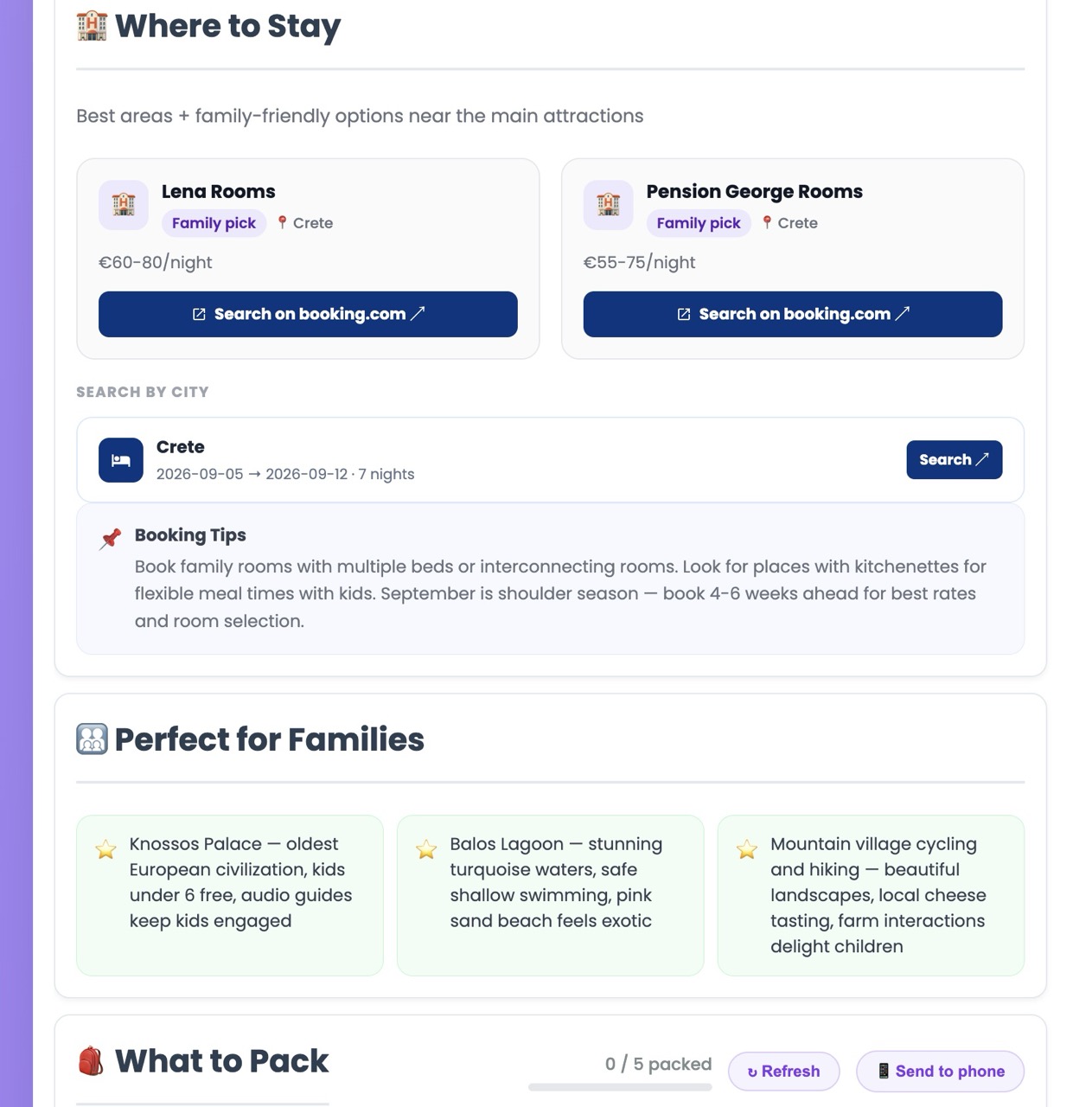
Family rooms named and priced: Lena Rooms €60–80/night, Pension George Rooms €55–75/night — both linked to booking.com
A budget split that lands on €3,000 exactly: €1,067 flights · €560 accommodation · €680 food · €450 activities · €193 transport · €50 insurance
Weather for the dates: 27°C average, three of eight days with light rain mid-week
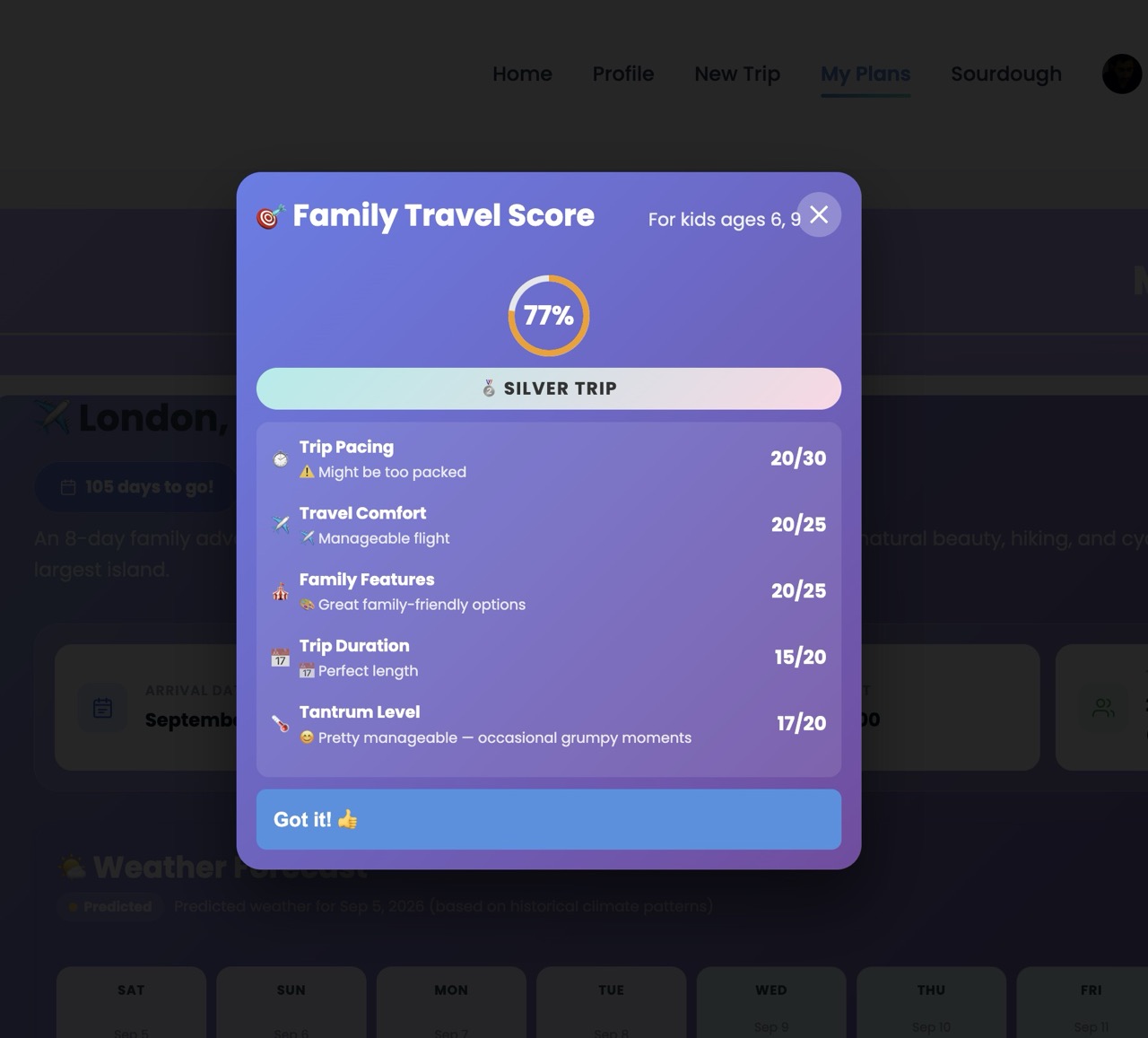
A Family Travel Score of 77% — "Silver Trip" — with a candid warning that the pacing might be a little packed for kids that age
The big picture — every day pinned on a map, the budget split that lands on €3,000 exactly, and a one-paragraph travel-route narrative.The detail — each day with timed activities, meal notes, pro tips and a built-in nap window.Accommodation, specifically — rooms named and priced, linked to booking.com, with a search-by-city for everything else.
What stood out wasn't the speed. The plan scored itself — 77%, Silver Trip — and openly flagged that the pacing might be too packed for kids aged 6 and 9, pointing at the specific days to slow down. That self-critique was more useful than the itinerary itself. Most planners are too polished to tell you what they got wrong.
The Family Travel Score that came with the plan — 77%, "Silver Trip," with a candid pacing warning.
This is the kind of plan that used to take a full weekend to put together. It took about three minutes.
What AI still can't do
To be fair: AI trip planning has real limits you should know going in.
It's a starting point, not a final answer. Always check that hotels actually have availability on your dates before getting attached to a plan. Flight prices fluctuate — the estimate you see is a real-time snapshot, not a guarantee.
Local knowledge still matters. An AI doesn't know that a particular beach is currently under construction, or that a restaurant it recommended closed six months ago. Cross-check anything important.
It can't feel what you feel. AI will give you an objectively "good" itinerary. But only you know that your 8-year-old would rather spend three days at a waterpark than visit every museum in the city.
Use AI to do the heavy lifting — flights, structure, budget, logistics — and then personalise from there.
Is it worth it?
If you're planning a family trip of any complexity — multiple flights, more than 4 nights, kids of different ages — yes, absolutely.
The hours you'd spend manually comparing flights, cross-referencing hotel reviews for family-friendliness, and building a day-by-day schedule that actually makes sense for your family? AI handles all of that in minutes.
The best results come when you're specific: don't just say "we want a beach holiday." Tell it your kids' exact ages, your non-negotiables (pool? direct flight? no more than a 3-hour journey with kids?), and your real budget. The more context it has, the better the plan.
Try it yourself
If you want to see what a plan looks like for your family, Famila.Travel is free to try — no account or credit card needed. Put in your destination, dates, and how many kids you're travelling with, and see what it generates.
It won't replace your judgment as a parent. But it'll do the part of trip planning that nobody actually enjoys.